Midas Golden Touch Strategy — Practical Tips for Every Budget
There is no way to influence the outcome of any spin in Midas Golden Touch. The RNG determines results independently. What you can control is your bet size, session length, and risk tolerance. The tips below are about bankroll management and understanding the slot's math — not about beating it.
Session Planning by Budget
Bankroll Rule: 200× Your Bet
With high volatility and an infrequent bonus trigger, plan for at least 200 spins per session. At €1 per spin, that means a €200 bankroll minimum. At €0.50, €100 covers the same session length. The bonus round carries most of the payout weight — running out of balance before triggering it is the primary risk.
Check the RTP Before You Spin
Open the info panel inside the game and verify the RTP reads 96.1%. If it shows 94% or lower, the casino is using a reduced-return configuration. A 2% difference in RTP translates to roughly €2 more lost per €100 wagered over time. This is not theoretical — it is the first thing to check.
Do Not Chase the Bonus
The free spins trigger is random and independent of previous spins. Spending 300 spins without a bonus does not increase the probability of the next spin triggering it. If your bankroll drops below 50 spins' worth of balance, stop. The slot does not owe you a bonus — this is the most common mistake in high-volatility games.
Wild Multipliers Work in Base Game Too
Do not ignore base game wins. A single wild on a payline doubles any win on that line. Two wilds quadruple it. A rare three-wild base game hit on a top-paying symbol line at €1 produces €600 (75× × 8 = 600). These hits are infrequent but meaningful for session balance.
Set Autoplay Loss Limits
If using autoplay, configure it to stop on any bonus trigger and to stop after a net loss of 50% of your starting balance. This prevents autopilot erosion and ensures you are present for the feature round where the real decisions (continue or cash out) matter.
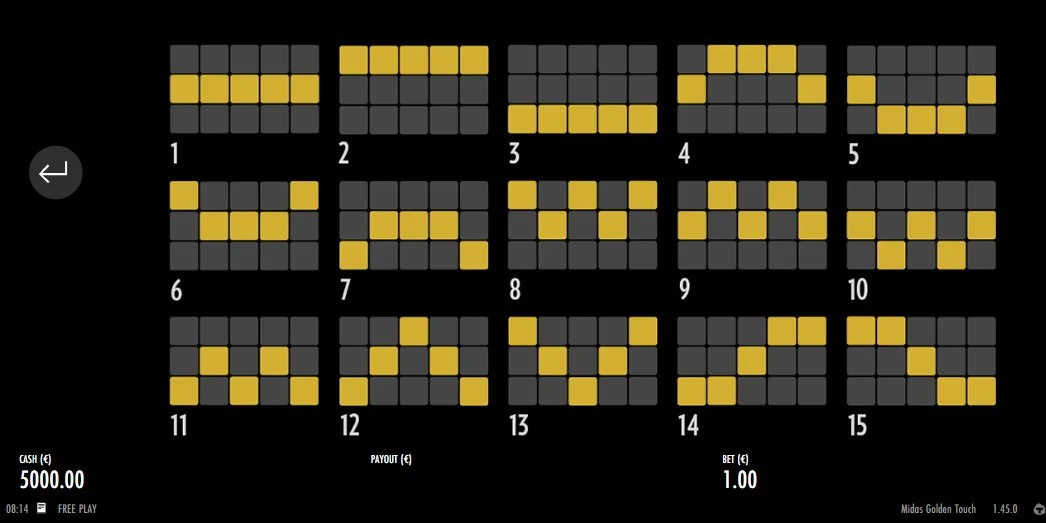
Understanding the 15 Paylines
Midas Golden Touch uses 15 fixed paylines — you cannot turn any off. Wins are evaluated left to right on each line, and only the highest win per line is paid. The payline patterns cover standard configurations: straight horizontals on rows 1, 2, and 3, plus V-shapes, zigzags, and diagonal sweeps. Knowing the patterns helps you recognise near-misses and understand why certain symbol arrangements pay while visually similar ones do not.